The Fabled Viking Sunstone*
(also known as Viking Compass)
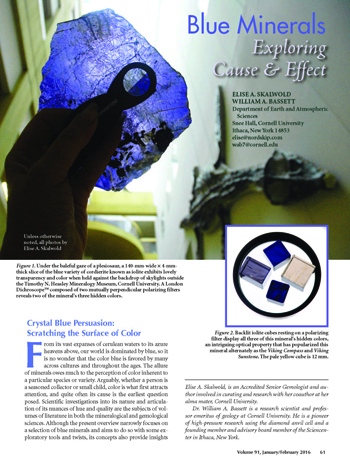
Iolite (cordierite).

Iolite (cordierite)
Photo: South Africa.
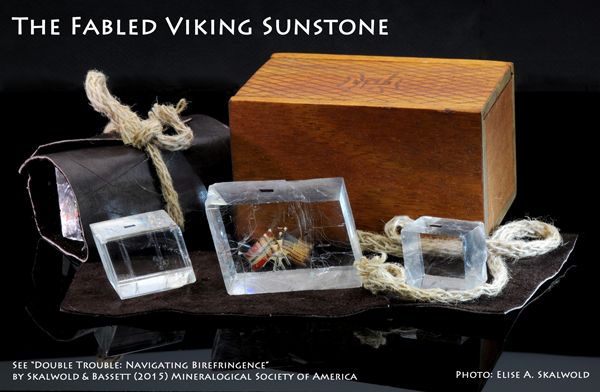
The intriguing theory of the Viking's use of a coveted stone to find their way in arctic waters has its roots in the ancient Viking Sagas, optical mineralogy, and in practical application by modern navigators.

Along with exploring the properties of these legendary sunstones, this section pays tribute to the work of the late Leif Karlsen and his wonderfully written and thoroughly researched "Secrets of the Viking Navigators."

*The term "Sunstone" in this paper is from the Nordic languages and refers to the stone as used by the Vikings; "sunstone" in the gem world is a varietal term and can refer to many different minerals, notably in the feldspar family.
Much more to come.
My thanks to those scientists and researchers who have been assisting me with technical details and who have been enthusiastically supportive for the Viking Sunstone teaching model.
Elise on Gaia.
A trip on "Gaia," a replica of the "Gokstad."
Sandefjord, Norway
Photo: E.Skalwold.


See a movie of the Gokstad Viking replica, "Gaia," sailing in Sandefjord, Norway on YouTube
The topic of Vikings, Viking navigation and the legend of the Viking Sunstone (also known as "Viking Compass") has been one which has captured my imagination since I was very young when my summers were spent in the historically Viking "rich" area of Vestfold Norway. This is where the famous ships "Oseberg" and "Gokstad" were found and where the ship barrows remain; inspiring dreams of voyages and a life in far distant times. As an adult, journey by sea at the stormy end of Winter in the North Sea from Iceland to the Faeroe Islands and on to Norway, as well as later in a tremendous night time storm in the sea around the Lofoton Islands, made very real the incredible skills of these ancient mariners. For more on the ships, see "The Oseberg,"
part of a wonderful website by Jørn Olav Løset.

Where did this whole idea of a Viking Compass or Sunstone start? First, the terms "Viking Sunstone" and "Viking Compass" are used to mean different things by different authors and they do not always apply to the minerals explored on these pages. Furthermore, the two terms are also both often used to describe the theoretical mineral itself... which could have been several different minerals. I adhere in this writing to Viking "Sunstone" referring to the fabled mineral reported in the Sagas.

As mentioned above, there is also the common use of "sunstone" in English referring to several completely different minerals in the feldspar family and unrelated to this whole theory. In some translations I have found what I believe is a misinterpretation of "Icelandic Spar" calcite ("kalspat", "calkspat" or "calcspar") as "feldspar" ("feltspat") which is then repeated as such in other places, eventually even interpreting it to mean aventurescent feldspar known as sunstone in English - I have even seen the man-made sunstone simulant, "goldstone" glass, pictured as Viking Compass or Sunstone - so one can see where the confusion escalates ("spar" translates to "spat" and visa versa in most Danish and Norwegian dictonaries). Though oligioclase feldspar sunstone is found in Norway, feldspar was never considered as a candidate for the Viking Sunstone; extensive twinning and inclusions would have inhibited its usefulness.

The theory of a mineral used to locate the
hidden sun by the mineral's polarizing optical properties was first put forth by the Danish archeologist, Thorkild Ramskou, who described it in his books Solstenen, Primitiv Navigation i Norden før Kompasset., 1969 and Solkompasset, 1982. He literally coined the expression "Viking Compass" (Vikingernes Kompas) as it is now connected to the mineral cordierite (iolite). The "Sunstone" (Solstenen) is the historical wording referring to such a mineral which he found in the Sagas as well as other texts. Thorkild Ramskou's books are well worth obtaining to appreciate his original thinking on the subject as recorded in his own words without the twisting of time and other purpose.

Though he found these historical references to a sunstone in the Sagas, there was a lack of hard evidence for just how the Vikings might have been able to locate the hidden sun (which would have sometimes been vital to navigation), either as archeological artifacts or detailed direction for their use. Both Ramskou and Leif Karlsen give plausible explanation for this lack and Karlsen later reports the recent finding of a calcite rhomb on a shipwreck of more recent origin.

The notion of the Viking's use of polarized light for navigation was an idea sparked by Ramskou's knowledge of the SAS trans-arctic pilots' use of a polaroid based instrument called the Twilight Compass (Kollsman Sky Compass, Sky Compass or Tusmørke-kompas) to determine the sun's location. He proposed that a local mineral might have been employed in the same way. Both the strong doubling of calcite and extreme pleochroism of various locally found minerals would have been obvious to anyone examining them - a skilled navigator could have easily surmised the implications for use by just gazing through the mineral and turning it various directions. It is just a thought Ramskau jumped on to try to answer his questions... since then it has captured the imaginations of sailors, scientists, history buffs, children, and people smitten with the beauty and lore of gems and minerals.
Click to learn more about the optics of calcite.

Learn more about the optics of calcite.


Click to learn more about the optics of iolite.Click to learn more about the optics of iolite.

Learn more about the optics of iolite.
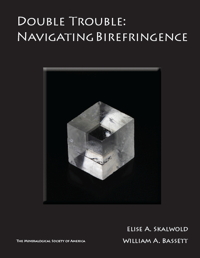
As a gemologist and educator, I would like to explore the optical properties of the proposed minerals thought to be the fabled Viking "Sunstone" - minerals which are considered gem materials today. This page is intended to provide ancillary material for a seminar I have been writing exploring the science behind the sunstone navigation theory.

There are several candidates for the mineral, among them "Iceland Spar" calcite, a coveted optical quality was found abundantly in Iceland, and iolite, the mineral cordierite found in Norway and popularly known as "Viking's Compass."
The choice of iolite is based on its strong pleochroism which can be used to determine the sun's position; the minerals tourmaline and andalusite have also been suggested for the same reason of strong pleochroism. Thorkild Ramskou favored iolite which is found in various regions of Norway, including Kragerø and Arendal. Repeated experiments with it on a DC-8 flight from Søndre Strømfjord to Copenhagen bore out his theory of its feasibility as a navigational aide..
Leif Karlsen makes a very strong case for Iceland Spar in his book "Secrets of the Viking Navigators." Mr. Karlsen was a professional navigator in the Merchant Marines with, as the title of his book suggests, a fascination for Viking navigation. His proposed technique is premised on the ready availability of optical quality calcite in Iceland which can even be found in the surface scree and which relies on this mineral's high birefringence (see section on calcite optics). Mr. Karlsen devised a plausible scenario as it might have happened more than 1000 years ago and which he found to be extremely accurate.

As a preview, check-out this little YouTube movie on Viking Navigation by NASASciFiles; about 3 minutes into the video there is a demonstration of the Viking Sunstone (in this case, calcite rhomb) just as Karlsen describes it: Viking Sunstone.

Interestingly, "a type of sky compass incorporating Iceland spar was invented by Ch. Wheatstone in 1848 and later improved on by others. Some models are illustrated in one of the series of papers on polarized light published by W. Spottiswoode in Nature ca. 1874, later in book form" (Dr. Leo Kristjansson, personal communication).

Go to The Karlsen section.

Go to the Karlsen section

Leif K. Karlsen's book.

Secrets of the Viking Navigators
by Leif K. Karlsen
Image: One Earth Press.
Bob Skalwold.

Bob Skalwold
In the early 1970's in the company of my father, who also taught navigation and was a long-distance sailor himself, I visited a maritime museum in his family hometown in Norway. There the curator talked about using the so-called sunstone in Viking times for determining the sun's position. He gave us a paper on it which you can read as a pdf "Solsten" - that is, if you read Norwegian - it describes a "semi-precious gemstone" which is used to polarize light to find the hidden location of the sun.
Since that time, my father has also been intrigued by the theory and while I was pursuing my gemological studies, asked me to investigate it further. He had often showed me the effects of polarizing filters and I delighted as a teen in helping him with sextant work while out sailing on Lake Ontario. For those reasons, we are so thrilled with Leif Karlsen's book on the subject..
*In Nordic languages, the Viking stone is called sunstone (Solsten or variants), but this is not to be confused with the many other minerals commonly called "sunstone" many of which are in the feldspar family. These could not possibly be a candidate. If you would like a brief overview of those feldspars, take a look at this as yet unfinished chart.

And, aside from the optics, how does any of this relate to gems? Well, whatever its identity, it was a very valuable possession and warranted mention in the ancient Viking Sagas.... not so diamonds - just to show how status changes.


Viking Sunstone Bibliography, References and Off-site Links to Further Information.
Reflections on The Viking Sunstone theory, gemology and the search for understanding in the larger world context:

"What interests me here is that gemology can be a pretext to open the door to many other things, it can create interest, questions and help us to discover with pleasure the rest of the world and the people living outside our normal circle of friends.

Unconfirmable things (the question as to whether the Vikings actually used a sunstone) have also their use in my opinion - if the question remains, then the interest to learn remains and the quest is still on. They are very powerful in fact, as they are fascinating for many people. If you find the answer to a question, then this is most of the time the end of the trip... I will say sadly.

We can see gemology as a human science (like history) or limit it as a science (like chemistry). Some people will be more interested in this or that aspect. Personally I love both equally.

In most of my interests: history, science, traveling, gems, animals, religions, philosophy there is one common link: searching. Some subjects mix all these interests (and) are then truly fascinating to me: "Iolite and Vikings," The origin and the history of historic spinels like the "black prince ruby" or the "Timur ruby","Bactrian" emeralds,"Golconda" diamonds, the origin of mysterious names like the "pigeon blood" term, and many more... my point about all that is that maybe it is not very useful to find out what is the true thing behind them, but the fact is that they are mysterious subjects full of unprovable facts (which add) a lot of romance to gems.

This is something I personally do appreciate a lot in gemology as a human science - meaning a mix of chemistry, physics, geology, history, religion, art... is that there are a lot of "unprovable things," a lot of mysteries behind them. These mysteries are truly fascinating as they give to many people around the world some motivation to search, to learn and at the end to speak with each other!

This is the magic behind it: a common interest and a common quest are the best way for people with a completely different background to feel good with each other, speak to each other and learn from each other. I witnessed that in many different places and occasions while traveling.

You see what I love in science, history or gemology is more about questions than answers: when there is no answer, when things are unprovable, when there is no "I'm right and you are wrong", then there is an open door to exchange ideas, communication and a way to help people to discover each other.

I've listened to many stories about gems (while) traveling and meeting gem people around the world. Most of the people mining and dealing with gems are among the poorest and less educated people (worldwide) if we look at them with our Western standards. If you listen to them, they will tell you about gem's incredible stories which may be 99% folklore or legends; but there is sometimes this 1% of hidden wisdom which will ring a bell in your mind... something that you have not thought about before, an idea that opens a door like a key on something you were wondering about before. It will maybe bring you nowhere, but you will think about it, you will get interested in this or that subject and you will search a little more. It may bring you nowhere, but you will be happy to search and to learn.

Finding the truth behind the Iolite and the (Viking theory) will not change anybody's life, but, it is a pleasant topic to (ponder), possibly useless... after all, gems are also useless things which are pleasant to look at... except if they can help a boat to find its way in the fog!"


Vincent Pardieu
The original "Travel Addicted Gemologist"
(printed with kind permission from the author)
Sunnmøre Ships.
The Sunnmøre Ships
Photo: E.Skalwold.


Continue to the Leif K. Karlsen Section

or

Go Back


Copyright © 2000-2008 Nordskip Designs.